
Why Did Your Watch Stop and What Should You Do?
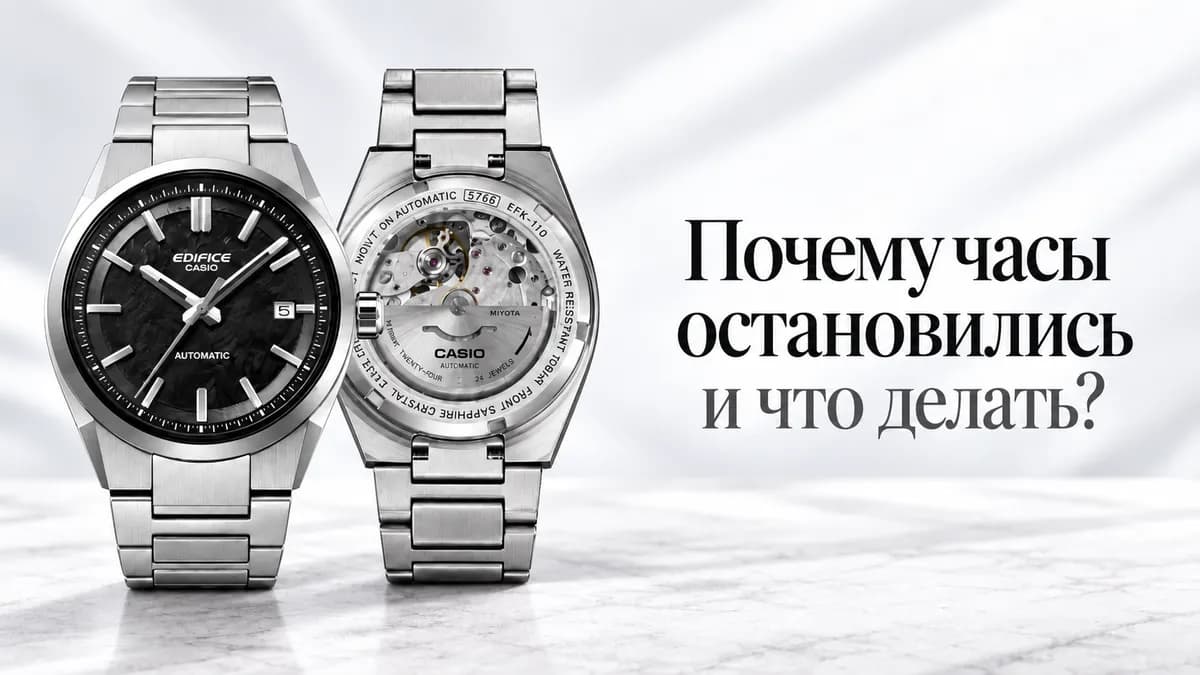
Why Did Your Watch Stop and What Should You Do?
If your wristwatch suddenly stops, it does not always mean there is a serious problem. The cause depends on the type of movement: with quartz watches, the issue is most often related to the battery, while with mechanical and automatic watches it is usually related to the power reserve.
However, a watch may also stop because of an impact, moisture entering the case, magnetization or a movement malfunction.
Let’s go through the main causes one by one.
1. The battery has run out
For quartz watches, this is one of the most common causes.
If the watch was working normally and then simply stopped, the battery should be checked first.
On some quartz models, before the battery is completely depleted, the seconds hand may begin moving unusually — for example, making larger jumps. However, not every movement has this indicator.
What to do: have the battery replaced by a watchmaker and, if necessary, have the case water resistance checked after the watch has been opened.
2. The mechanical watch has run out of power reserve
Mechanical watches do not need a battery — they receive energy from a wound mainspring.
If the watch has been left without movement for a long time, the power reserve gradually runs out and the movement stops.
In automatic watches, energy is usually replenished through the movement of the wrist.
What to do: if the movement supports manual winding, carefully wind the watch with several smooth turns of the crown and then set the correct time.
Once it starts running, it is a good idea to wear the automatic watch for a while.
3. The automatic watch stopped overnight
This does not necessarily indicate a malfunction.
If the watch was worn only briefly, taken off for a long period or the wrist did not move enough, the movement may simply not have accumulated enough power reserve.
For example, the watch may be running in the evening but have stopped by morning.
If this happens regularly even after sufficient wear and winding, the condition of the movement should be checked.
4. The watch suffered a strong impact
A fall or strong impact can affect both mechanical and quartz watches.
After an impact, the watch may:
- stop completely;
- begin gaining or losing time noticeably;
- run intermittently;
- stop again after some time.
In this situation, it is better not to keep experimenting with the watch settings.
Have it inspected by a watchmaker.
5. Water or moisture entered the case
If the watch stopped after contact with water and condensation or droplets appeared under the crystal, the cause may be a loss of water resistance.
Moisture is dangerous not only for the electronic components of quartz watches, but also for the metal parts of a mechanical movement.
If you can see water or fogging inside the watch — stop exposing it to water and take it to a watchmaker as soon as possible.
Do not try to dry the watch with a hair dryer or open the case yourself.
6. The mechanical watch may have become magnetized
A magnetic field can affect the operation of a mechanical movement.
Possible sources of strong magnetic fields include some speakers, magnetic clasps, accessories with magnets and various electronic devices.
Magnetization more often causes a noticeable change in accuracy rather than a complete stop — the watch may start running significantly fast or become unstable.
If the watch’s rate suddenly changes without an obvious reason, a watchmaker can check the movement for magnetization and demagnetize it if necessary.
7. A Solar watch may have run out of charge
If a watch is powered by light, the absence of a conventional battery does not mean it can never stop.
Solar models store energy in an internal rechargeable battery. If the watch remains in darkness for a long time, the charge level can become too low.
What to do: expose the watch to sufficient light according to the instructions for the specific model.
Recovery time depends on the movement and the level of discharge.
8. The watch may need servicing
If the cause is not related to the battery or power reserve, the movement itself may need to be inspected.
Over time, its operation can be affected by:
- natural wear of components;
- the condition of lubricants;
- contamination;
- the consequences of an impact;
- moisture entering the case;
- malfunctioning individual components.
You should especially visit a watchmaker if the watch:
- stops regularly;
- starts and then stops again;
- begins gaining or losing a lot of time;
- stopped after a fall;
- fogged up from the inside;
- does not start after a battery replacement or winding.
What can you check yourself?
Before visiting a service center, you can check a few simple things.
If the watch is quartz:
check when the battery was last replaced.
If the watch is automatic or mechanical:
check whether it has any power reserve and whether the movement can be manually wound.
If the watch is Solar:
make sure it has received enough light.
If the watch was dropped or came into contact with water:
it is better to take it directly to a watchmaker.
It is not recommended to open the case yourself, disassemble the movement or try to solve the problem by applying strong heat.
WATCHZ conclusion
If your watch has stopped, the first step is to identify the type of movement.
Quartz → first check the battery.
Automatic / Mechanical → check the power reserve and winding.
Solar → check the level of charge from light.
If the watch stopped after an impact or contact with water, is running inconsistently or does not start after basic checks, it is better to take it to a watchmaker.
The main thing is not to treat every stopped watch as a serious breakdown, but also not to ignore the problem if it keeps happening.